
Industrial exhaust fans
Heavy-duty drop hammer fans that pull heat and fumes out of large sheds
An industrial exhaust fan pulls hot, stale or fume-laden air out of a building so fresh air can flow in through doors, louvres or cooling pads. E-Cool supplies drop hammer exhaust fans in 32, 40 and 54 inch sizes (800, 1000 and 1380 mm), moving 18,000 to 44,000 m³ of air an hour.
The drop hammer (gravity shutter) closes the louvres when the fan stops, keeping out rain, dust and birds. Every model has six SS-304 stainless steel blades, a 1.2 mm thick body and runs at 70 dB or less, so it suits factories, warehouses, workshops, godowns, commercial kitchens, greenhouses and poultry houses.
Compare models
Six models: three sizes, belt or direct drive
| Size | Drive | Motor / supply | Airflow | Pressure | Weight |
|---|---|---|---|---|---|
| 32 inch (800 mm) | Belt and pulley | 1 or 3 phase | 18,000 m³/h | 80 Pa | 53 kg |
| 32 inch (800 mm) | Direct drive | 0.37 kW | 18,000 m³/h | 80 Pa | 53 kg |
| 40 inch (1000 mm) | Belt and pulley | 1 or 3 phase | 23,000 m³/h | 100 Pa | 95 kg |
| 40 inch (1000 mm) | Direct drive | 0.55 kW | 23,000 m³/h | 100 Pa | 95 kg |
| 54 inch (1380 mm) | Belt and pulley | 1 or 3 phase | 44,000 m³/h | 130 Pa | 180 kg |
| 54 inch (1380 mm) | Direct drive | 1.1 kW | 44,000 m³/h | 130 Pa | 180 kg |
All models are 400 mm deep. Belt-and-pulley models run on single or three phase; direct-drive models use a motor fixed straight to the blades.
Belt or direct drive?
Choosing the drive
| Belt and pulley | Direct drive | |
|---|---|---|
| How it works | Motor turns the blades through a belt and pulley | Blades sit on the motor shaft |
| Maintenance | Belt tension checks and belt changes over time | No belt or pulley to wear out or adjust |
| Power supply | Single or three phase | Three phase motors (0.37 to 1.1 kW) |
| Best for | Sites with single-phase supply, or where a familiar design is preferred | Round-the-clock running where downtime and upkeep must stay low |
All models
Exhaust fans in the range
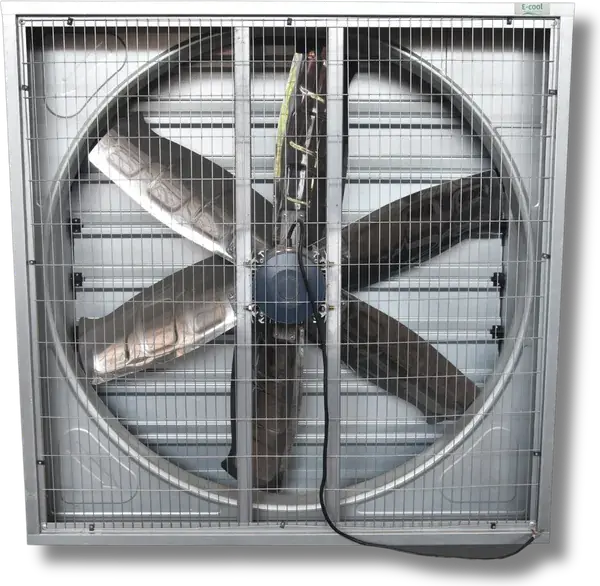
Direct Drop Hammer Exhaust Fan 800 mm
XD80 · 0.37 kW · 18,000 m³/h
Direct Drop Hammer Exhaust Fan 1000 mm
XD100 · 0.55 kW · 23,000 m³/h
Direct Drop Hammer Exhaust Fan 1380 mm
XD138 · 1.1 kW · 44,000 m³/h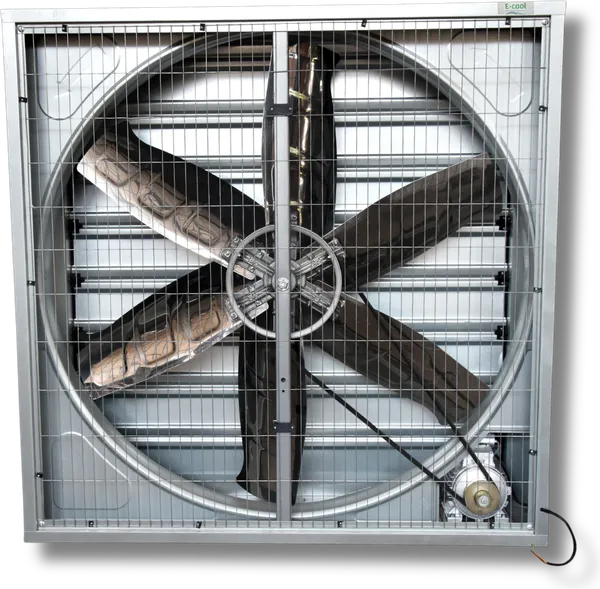
Drop Hammer Exhaust Fan 800 mm
XH80 · pulley driven · 18,000 m³/h
Drop Hammer Exhaust Fan 1000 mm
XH100 · pulley driven · 23,000 m³/h
Drop Hammer Exhaust Fan 1380 mm
XH138 · pulley driven · 44,000 m³/hSizing
How many exhaust fans does a shed need?
Work out the volume of the space (length × width × average height, in m³), multiply it by the number of air changes per hour the work needs, and divide by the fan airflow. For example, a 2,000 m³ shed at 20 air changes an hour needs 40,000 m³/h, which is two 40 inch fans or one 54 inch fan.
Hot processes such as forging, foundries and kitchens need more air changes than storage. Place fans on the side away from the air inlets so air sweeps across the whole floor. For poultry houses and greenhouses, see poultry fans, which are sized by air speed instead.
Where they work
Industries that use our exhaust fans
Factories and workshops
Removes heat, smoke and fumes from production floors and fabrication bays.
Warehouses and godowns
Keeps stored goods dry and the air fresh in large sheds.
Poultry houses
Tunnel ventilation with cooling pads; see poultry fans.
Greenhouses
Pulls air through pad walls to cool and ventilate crops.
Commercial kitchens
Moves heat and cooking fumes out of busy kitchens.
With industrial coolers
Exhaust fans give cooled air an exit, so industrial coolers work better.
FAQ
Exhaust Fans: common questions
What sizes of industrial exhaust fan do you supply?
32, 40 and 54 inch drop hammer exhaust fans (800, 1000 and 1380 mm), each in belt-and-pulley and direct-drive versions.
How much air does a 54 inch exhaust fan move?
The 54 inch (1380 mm) model moves about 44,000 m³ of air an hour at 130 Pa total pressure.
What is a drop hammer exhaust fan?
It is a box-type exhaust fan with a gravity shutter: weighted louvres open when the fan runs and drop shut when it stops, keeping out rain, dust and birds.
Belt drive or direct drive, which is better?
Direct drive needs less maintenance because there is no belt or pulley. Belt-drive models suit single-phase supply. Both move the same air for the same size.
Are the blades stainless steel?
Yes. All models have six SS-304 stainless steel blades and a 1.2 mm thick body.
How loud are they?
All models run at 70 dB or less.
How many exhaust fans do I need?
Multiply the room volume by the air changes per hour needed and divide by the fan airflow. Our team can calculate it for your site.
What is the HSN code for exhaust fans?
E-Cool invoices exhaust fans under HSN 8414 59 90.
Need help choosing?
Tell us the space and what you need to cool. Our sales team will suggest the right models and send a quotation.